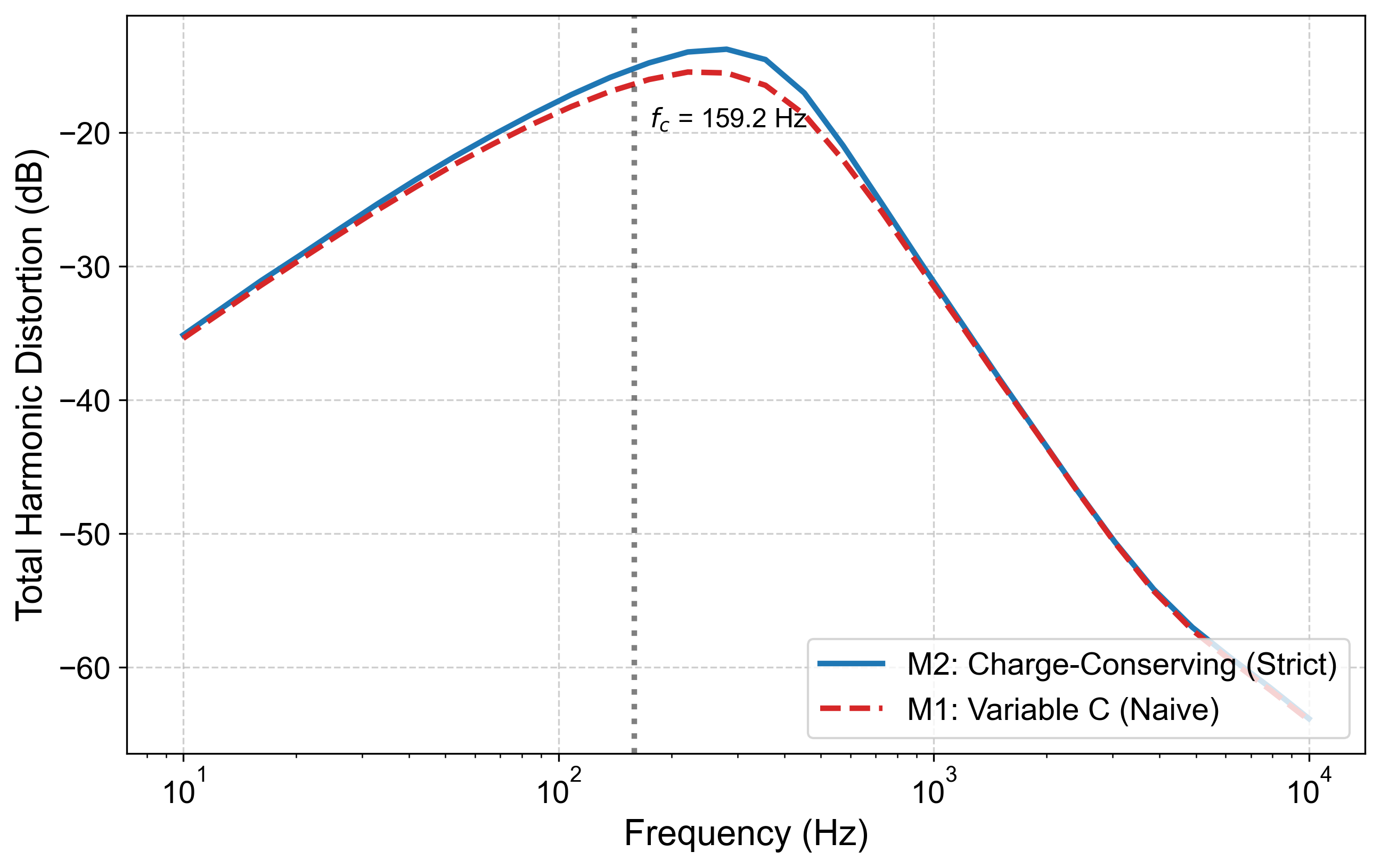
The transition band is the critical region
In a nonlinear RC low-pass network, capacitor voltage swing and circuit current are simultaneously significant near cutoff. That is where output THD can peak.
HighSNR Lab · Application Note AN-001 · Public Release
Why THD peaks near the RC transition band—and how an incorrect C(V) update can create false harmonics.
A concise engineering note for analog designers, signal-chain engineers, and model developers working with X7R and X5R MLCCs.
Engineering takeaways
In a nonlinear RC low-pass network, capacitor voltage swing and circuit current are simultaneously significant near cutoff. That is where output THD can peak.
A locally frozen capacitance update can violate the charge relation. A credible nonlinear model should be formulated and checked through Q(V).
If a simulated harmonic result moves when the time step is reduced, it is a numerical diagnostic—not yet a dielectric prediction.
Controlled simulation
The charge-consistent model captures the physical interaction between nonlinear capacitor current, resistor voltage drop, and output attenuation. The comparison model is deliberately coarse and is included as a numerical counterexample.
Real-component context
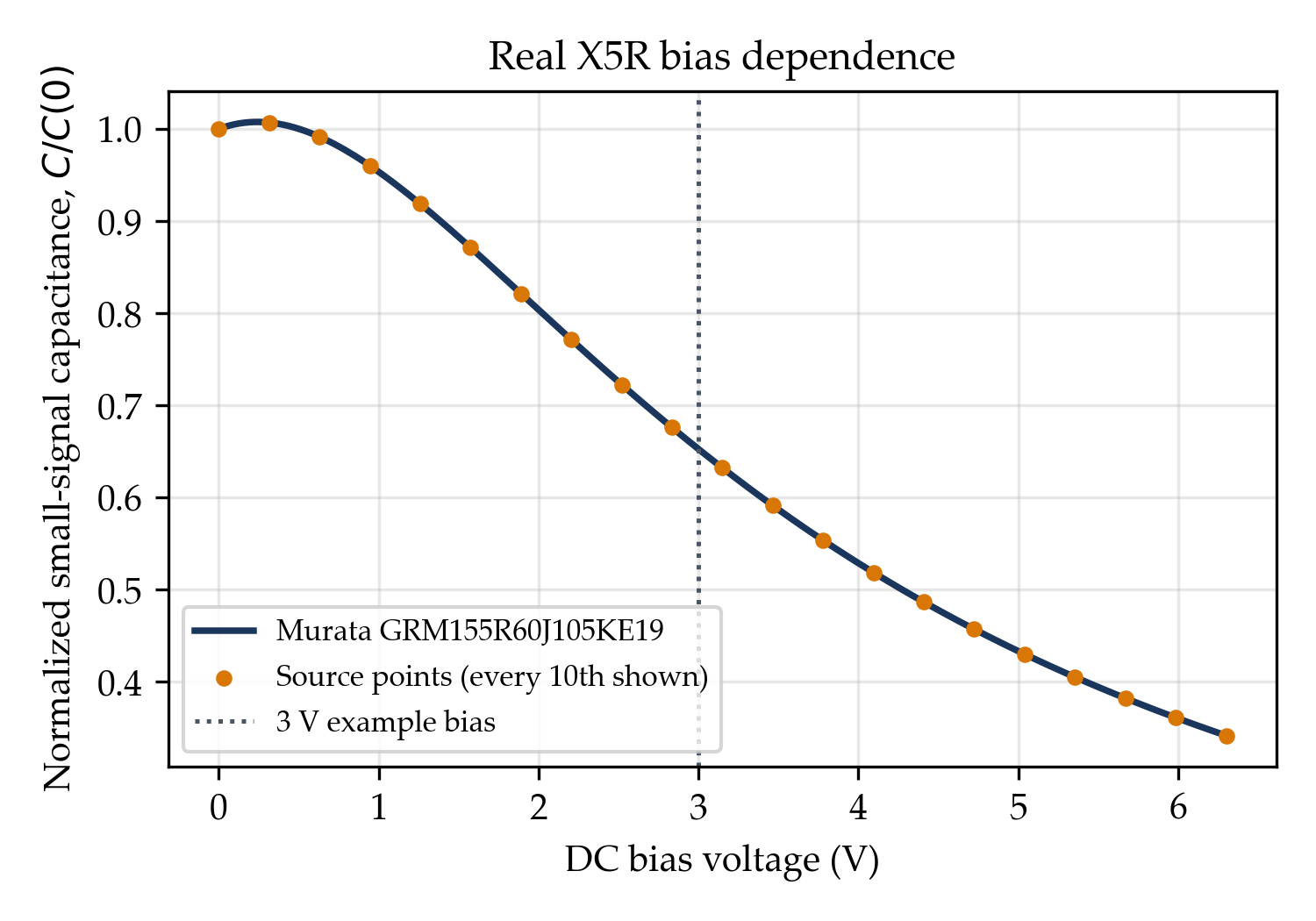
AN-001 keeps its main simulation deliberately controlled, then adds a separate vendor-data case to show realistic DC-bias curvature. The vendor curve is not presented as a measured large-signal THD model.
Source limitations are disclosed: the export does not record measurement frequency, dwell time, sweep direction, or uncertainty.
Open release package
Independent engineering review
HighSNR Lab reviews component models, operating assumptions, convergence, and distortion risk in precision analog signal paths.