Research Note · Measurement Infrastructure
From Budget Constraint to Measurement Platform
Why the QuantAsylum QA403 changed the experimental plan
The QA403 is not being treated as a universal replacement for a high-end laboratory analyzer. It is being used as a practical, programmable measurement engine for the next stage of the HighSNR Lab MLCC research program.
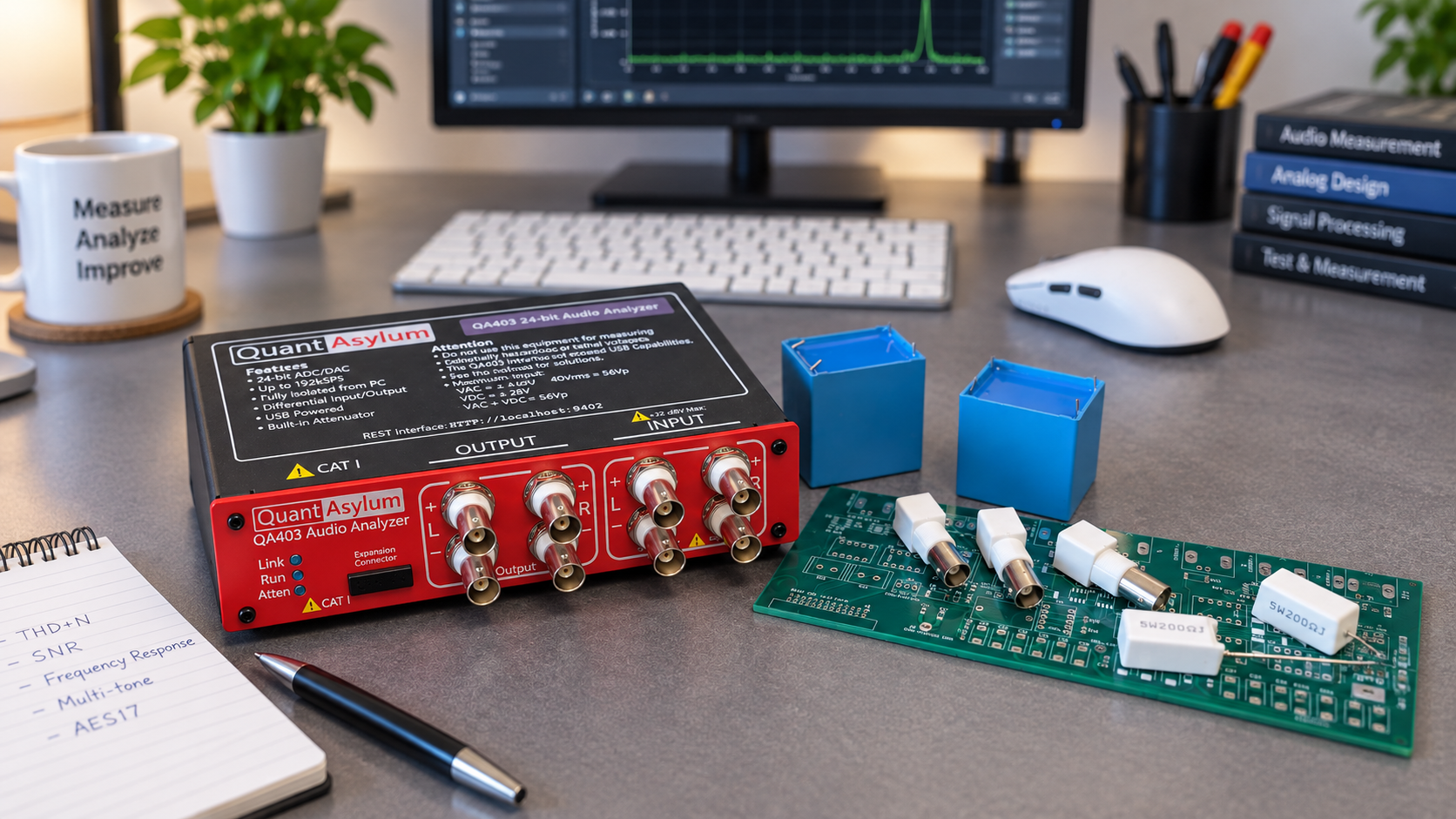
The QA403 and the custom MLCC measurement PCB are now in hand. The next step is to establish a loopback baseline and validate the measurement procedure before starting the component comparison campaign.
The equipment problem
In an engineering research project, the availability of suitable test equipment can become the main constraint. For some time, I had been looking for an analyzer that would allow me to move from simulations to measurements of real ceramic capacitors in passive RC filters.
Professional instruments capable of covering this class of work can cost several thousand dollars. For an independent research project, that creates a practical barrier: the experimental part of the program has to wait until the equipment budget becomes available.
The goal was therefore not to find the most capable analyzer on the market. The goal was to find an instrument whose measured performance and workflow were sufficient for the specific research questions at the current stage.
What the measurement system needed to do
The instrument had to support a repeatable workflow for studying voltage-dependent nonlinearity in Class II MLCCs. The practical requirements were:
- Measure small nonlinear distortion components with a sufficiently low noise and distortion floor.
- Generate and acquire controlled analog signals through a real passive filter and capacitor under test.
- Support measurements across frequency, signal level, and DC-bias conditions.
- Provide enough input flexibility for the voltage and current channels of the test fixture.
- Allow the measurement process and data analysis to be automated in Python.
These requirements are narrower than the specification of a general-purpose metrology instrument. They are also more useful for deciding whether a particular instrument can answer a particular research question.
Why the QA403 was a practical fit
The QuantAsylum QA403 matched the key requirements of the current measurement plan. It supports THD, THD+N, noise, and frequency-response measurements, as well as automated sweeps such as distortion versus frequency or signal level.
Its differential inputs, multiple input ranges, and isolated architecture are useful for analog test circuits where signal integrity and ground-loop problems can affect the result. The analyzer can provide the stimulus and acquire the response from the same measurement setup, which is important when the test is intended to compare small distortion components.
The conclusion was not that the QA403 would solve every measurement problem. The conclusion was that its capabilities were adequate for the next experiment: comparing real X7R capacitors under controlled DC bias and connecting the measurements to the models developed in AN-001.
The programming interface changes the workflow
The feature that mattered most was not a single number in the specification sheet. It was the software interface.
The QA403 exposes a local HTTP API based on GET and PUT requests. External software can use the interface to control measurements and retrieve both processed results and raw time- and frequency-domain data. The connection is local to the QA403 application; it is not a claim that the instrument is controlled by a generic network protocol directly over the Internet.
This makes it possible to treat the analyzer as part of a reproducible research workflow rather than as a device operated only from a graphical interface. Measurement setup, sweep control, data capture, FFT processing, and result storage can be connected in one versioned Python workflow.
That changes the structure of the research program. Until now, much of the work had focused on vendor C–V data, charge-based Q(V) models, simulations, and analytical estimates of distortion. The QA403 makes it possible to compare those predictions with the behavior of real components in a real circuit.
The conversation with Matt
The communication with Matt from QuantAsylum was an important part of the decision. After I described the project, Matt did not simply suggest a product. He proposed a concrete experiment: compare 6.3 V and 50 V X7R capacitors at different DC-bias levels.
He also pointed out that C0G/NP0 capacitors might be below the QA403 measurement floor. That observation is useful because it defines the role of the control measurement. A result below the instrument floor is not automatically a failed experiment; it can establish the practical sensitivity limit of the complete measurement path.
This moved the discussion from a general request for equipment to a specific research question that both sides could understand and evaluate.
The project is now moving
In early August, QuantAsylum provided a QA403 as a promotional unit at no cost. The analyzer arrived in late August, and the custom measurement PCB has now arrived as well.
The project has therefore moved from simulation and measurement-system design to physical validation. The first measurement sequence will include a loopback baseline, a check of the residual distortion and noise floor, and a controlled comparison of X7R parts rated for 6.3 V and 50 V. C0G/NP0 parts will serve as a control where their signal remains measurable above the system floor.
The measurement results will then be compared with the predictions from the existing MLCC models and used to define the next revision of the test procedure.
Disclosure and independence
QuantAsylum provided the instrument in support of this research. The measurement methods, data processing, and technical conclusions remain independent. This support will be disclosed in every publication that uses the QA403.
The purpose of this note is not to present a product endorsement or a complete product review. It documents an equipment decision and explains why a programmable, accessible instrument can change the structure of an independent research program.
Research transition
From predicted behavior to measured behavior
The QA403 does not replace the models, the test fixture, or the need for calibration. It makes the next question possible: how closely does the behavior of a real MLCC in a real filter match the behavior predicted by the model?